All about teeth
Teeth numbering
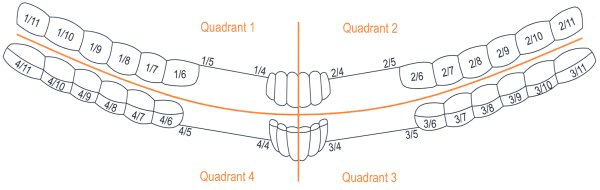
In order for dentists and veterinarians to be able to discuss problems with horses’ teeth accurately, a numbering system was introduced for the teeth.
Looking at a horse from the front, you need to imagine a cross that has a vertical line drawn between the teeth in the front and the horizontal line drawn in between the jaws. We have now divided the mouth into four quadrants. Starting in the top left quadrant: this quadrant is referred to as quadrant 1. Moving clockwise, the top right quadrant is quadrant 2; the bottom right, quadrant 3; and the bottom left, quadrant 4.
The teeth were then numbered within their quadrant. In quadrant 1, the incisor at the front, just to the left of the vertical line, is tooth number 1, the next incisor is tooth number 2, and so on. The incisors take tooth numbers 1 to 3, the canine (if present) is number 4, the wolf tooth (if present) is number 5, the pre-molars are numbers 6 to 8 and the molars are numbers 9 to 11.
Bit seating
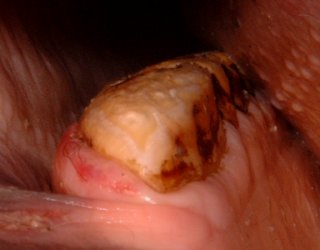
“Bit seating”, or a “bit seat”, refers to the rounding and smoothing of the surface of the number 6 pre-molar teeth (these are considered the second pre-molars, as the wolf tooth counts as the first pre-molar) in the horse. The procedure is often done to performance horses, as it is believed to improve athletic performance.
The number 6 is the tooth that acts as a stop for the bit. Horses that wear snaffle bits are believed to receive the most benefit, as this jointed bit acts by squeezing the edge of the lip between it and the number 6 premolar.
Tissue damage
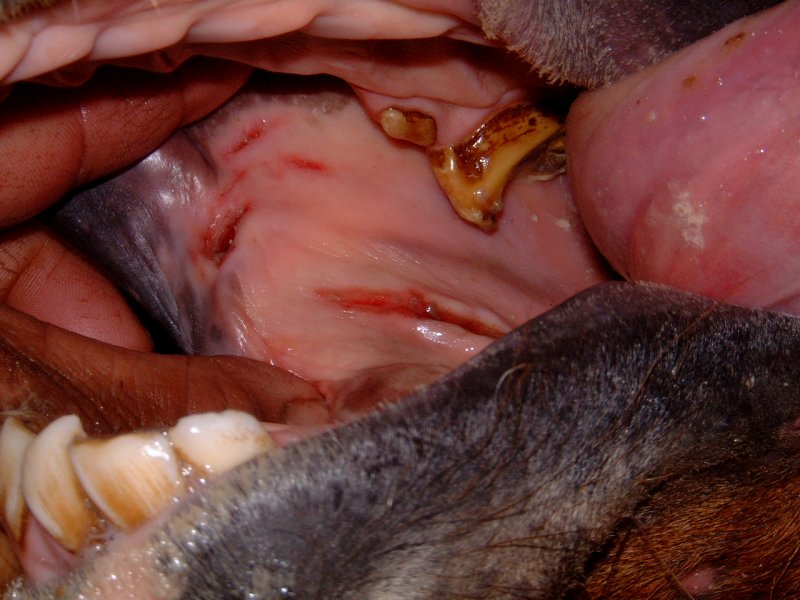
This horse had large hooks on the upper second premolars and, as a result, you can see the lacerations to the horse’s cheek.
In domesticated horses, items like bits, nosebands and head collars do not allow the horse to keep the teeth away from the cheek, and the problem just gets worse and worse. A good reason to have regular dental inspections.
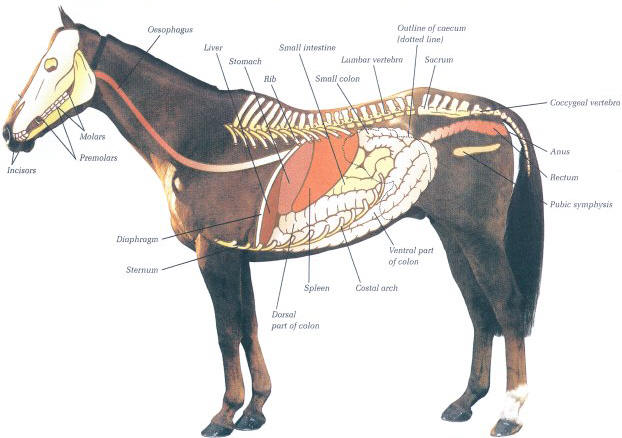
The digestive system
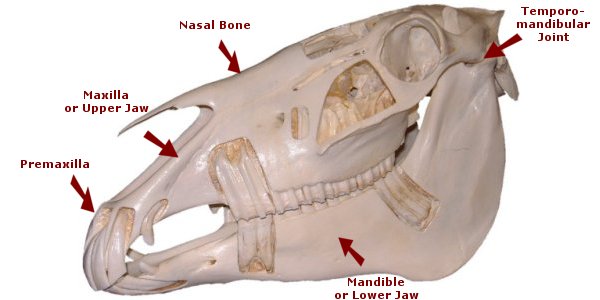
Bones of the head
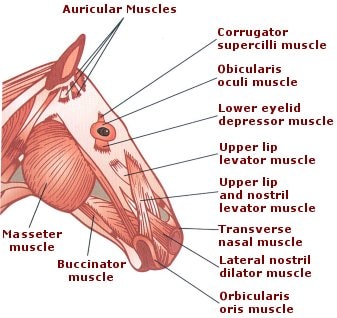
Muscles of the head